
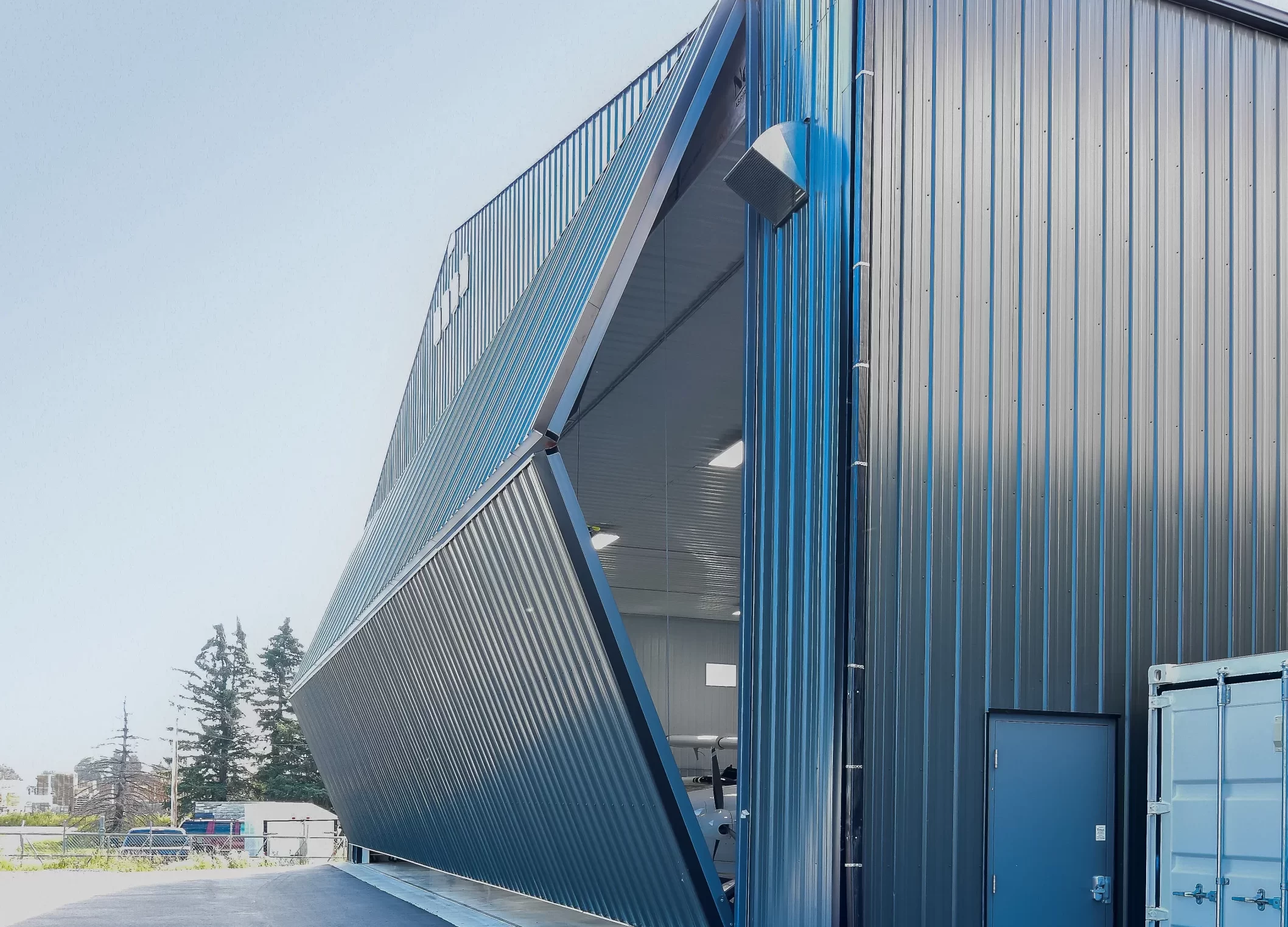
Whether it’s a busy farmyard or bustling airport, safety is a top priority for all of us. It pays to be cautious around large, moving equipment, and your door is no exception. Safety and quality are key components of our door design, and are never an afterthought. Here’s how Diamond overhead bifold doors are designed to keep you, your loved ones, and your equipment safe and protected.
A Strong and Durable Door Frame
For overhead bifold doors, safety starts with the basics – a strong and durable door frame.
Our bifold door frames are manufactured from HSS tubular steel, providing a lightweight but strong base for the rest of the door. A triple internal truss system adds even more strength to the frame, especially for those very wide aviation doors, or in high wind areas.
Finally, our CWB certified welders assemble the frame using nationally approved welding techniques, ensuring a door frame that will last for many years to come.
Cold Roll Formed Hinges
An essential part of the door frame, our unique cold roll formed steel hinges secure the door to your building. Cold roll formed means that we make each of our hinges from solid steel. We bend and shape this steel at room temperature to add 20% more strength to the hinge (compared to traditional manufacturing processes).
Reliable Electric Lift Motor
Power failure is often a major concern for many door owners, especially when the door is open. Understandably so, as no one wants to see their door come down on that shiny new combine or airplane. However, we design our overhead bifold doors with several features to ensure your safety should a power failure occur. The first feature is the electric brake motor.
What is an electric brake motor?
An electric brake motor is unique in that it engages the brake whenever there is no power to the motor. In the case of a bifold door, this means that if there is a power failure at any point while the door is in motion, the brake automatically stops the door from moving.
Operating Your Bifold Door During a Power Failure
If the power is out for a while, you may quickly realize that you still need to open and close your door. Our motors include an emergency manual operator that allow you to safely operate your bifold door in case of an emergency. (For assistance, please contact our service department at (866) 325-7600. For after hours emergency assistance, please use (216) 677-3667.)
Secondary Safety Features for Overhead Bifold Doors
Another safety feature that we’ve included in the lift system design is the worm gear drive system. It acts as a back up safety feature to our main safety feature (the electric brake) by preventing the drive system from turning backwards. This additional feature is a secondary measure to hold the door securely in place while the door is open.
Photo Electric Safety Sensors (Photo Eyes)
Just like on your garage door at home, our photo electric safety sensors (photo eyes) provide reassurance that nothing is in the doorway while your bifold door is closing. We include a set of photo eyes with every door, which allows for convenient, push-and-walk-away door operation without the worry of something running under the door.
Pinch Points and Entrapment Hazards
Like any other large piece of equipment, a bifold door does have some pinch points and entrapment hazards. However, we’ve taken steps to reduce or eliminate these hazards altogether.
Safety shields around the motor and gearbox ensure that hands, loose clothing, or stray items hanging around your overhead bifold door are kept safely away from danger.
Cable guards (those black plastic pieces that are fastened to the driveline) eliminate any pinch hazard as the cables wrap around the driveline.
10x Cable Safety Factor
Overhead bifold doors are relatively heavy, and while a properly installed door and well-built building won’t cause an issue in terms of structural soundness, we want to be sure that when open, it will stay safely in place.
That’s why Diamond doors are designed with a 10x cable safety factor. This means that our lift system is designed to handle ten times more than the weight of the door. Our unique system also eliminates the common wear and tear caused by overlapping cables, meaning that your cables will last for many years without failing.
However, if a cable breaks due to accidental damage, you don’t need to worry about the safety of your overhead bifold door. (We do recommend ordering a replacement cable as soon as possible.)
How you can prevent accidents and injuries
We do everything we can to build your overhead bifold door for safety and reliability. However, there are some things that only you can do to prevent accidents and injuries. Here’s what we recommend.
Door Inspections and Maintenance
The owners manual, included with your bifold door, outlines how to inspect your door to ensure it is functioning properly. While you should complete these inspections regularly, they don’t take long to complete and don’t require any special equipment.
Here are a few areas that may require special attention.
Lift Cables
With your bifold door closed, inspect your lift cables to ensure that there is no fraying or other damage. If you discover any damage, please contact our service department as soon as possible for a replacement cable.
Also check your cables to ensure that they are properly tensioned. All cables should have a similar tension. You can check this by pulling the cable away from the door and measuring the distance from the frame to the cable. The cables should hang loosely when the door is fully closed, but not fall too loosely. They should not fall away from the Y pushers.
Photo Eyes
Without properly installed photo eyes, you will need to press and hold the “close” button for the door to cycle shut. However, you can safely check that your photo eyes are working by pressing the “close” button and then passing a broom between the photo eyes. Your door should immediately stop.
DO NOT stand beneath the door to test the function of your photo eyes.
If your door does not stop, contact our service department for assistance and troubleshooting.
General Door Inspection
Open and close your bifold door, listening closely for any unusual noises. Watch to ensure that the door travels smoothly, and stops at the appropriate open and close locations.
Use Caution When Operating Your Door
Finally, be sure to always use caution when operating your bifold door. Make sure that there is no equipment parked in the pathway of the door (when opening or closing). Also make sure that other people are away from the door before it begins moving.
Avoid operating your door in extreme winds and keep it closed and locked during storms.
Have Questions?
Do you have further questions about the safety of an overhead bifold door? Our sales team is happy to answer them. Call our office at (866) 325-7600 anytime between 8:00 am and 5:00 pm CST, Monday to Friday. You can also send an email to info@diamonddoors.com.
